 Liquid Droplets
Introduction
Droplets are interacting Lagrangian spheres that can access continuous positions across the fluid lattice. Droplets are typically used to model two-fluid droplet dispersion, but also have application to blending density-stratified miscible fluids
Each droplet has a rigid core that interacts elastically with the rigid cores of other dispersed-phase particles. The purpose of the hard sphere interactions is to ensure that the initial dispersed phase volume remains incompressible prior to droplet breakup/dispersion.
Surrounding each rigid core is a fully penetrable concentric exterior shell which increases the apparent volume of the particle. The purpose of the shell is to allow the dispersed phase volume fraction to overcome the 0.62 limit on volume fraction presented by random sphere packing. That is, by accounting for the interstitial region between a random pack of rigid spheres, the dispersed phase volume fraction reconstructed from the cherry-pit particles can realize values close to 1.0.
Droplets enter the system within as monodisperse particles located within the children geometry of the droplet parent. The droplet volume fraction and size distribution can inform the local fluid viscosity via a user-defined rheology. Droplet positions and velocities evolve according to Newton’s Second Law using a Verlet algorithm advanced at the simulation time step. The forces included in the velocity update are defined by the user.
Upon entering the simulation domain, each droplet is assigned an ID, a birth timestamp, a diameter, and an origin ID. The birth timestamp identifies the time step at which each droplet enters the system. This value is particularly useful in predicting droplet residence time distributions and droplet mean age. The origin ID describes where a droplet entered the system. This value is useful in predicting how droplets from various sources blend and transfer mass to/from the fluid. It is also useful in predicting how droplets with different properties (e.g., density and diameter) are affected by fluid motion (assuming different droplet properties are assigned to the different droplet origins).
Breakup occurs on the level of individual droplet or using a parcel approach. In either approach, the daughter diameter is informed by the physical properties of the droplet and the kinematic properties of the fluid. Coalescence also occurs at the level of individual droplets or using a parcel approach. In the former, coalescence is informed by the kinematic properties of the two droplets. In the latter, changes in the parcel diameter are informed by the kinematic properties of the fluid.
Mass transfer between droplets and the surrounding fluid are discussed dropletScalar. The mass transfer coefficient of each droplet is a user-defined function governed by local fluid properties. This droplet-specific mass transfer rate multiplied by the local droplet/fluid concentration difference defines the mass transfer rate between droplets and the surrounding fluid. Mass leaving/entering the droplet causes the droplet to shrink/grow in a way that conserves total species mass.
Note
Droplet image files are printed at the same frequency as slices and volumes.
Property Grid
General
- Injection Option
Injection option.
- Dump
TBA.
- Initial Packing
This option describes where the initial volume fraction of the dispersed phase/droplets within the system.
- Auto
Set number of packed droplets based on initial droplet diameter and voxelized volume at runtime. The dispersed phase volume fraction is assumed to be 1.0 and the number of initial droplets is calculated at runtime to fill the child geometry.
- Custom
User-defined expression defining the number of droplets initially injected into the child geometry. This expression may be a function of the child volume, enabling the user to define a local dispersed phase volume fraction.
- Initial Packing Volume Fraction
Definition
- Dump Time UDF
s | Time to begin droplet addition.
- No Injection
TBA.
- Density
kg/m 3 | Density of the dispersed phase droplets.
Note
In addition to hard sphere droplet-droplet interactions, the trajectories of each droplet are informed by the weight, buoyancy, drag, and virtual mass forces.
Volumetric Generation
This functionality is used to dynamically generate particles across the fluid domain according to user-defined generation criteria. The generation criteria are applied on a voxel-by-voxel basis and can be a function of local fluid properties and/or system-level variables. Volumetric generation is typically used to model nucleation processes.
- Enabled
Enable an injection based on local fluid conditions.
- On
Volumetric generation enabled.
- Interval
Time interval at which the generation criteria is tested. Shortening this interval increases the frequency at which the injection criteria is tested.
- Injection Condition UDF
dimensionless and m | This UDF defines the local conditions for particle injection as part of a volumetric particle generation routine. It requires two output variables: a Boolean named
injectand a floating-point variable namedd.The
injectBoolean determines whether particle injection occurs in each voxel. Ifinjectis true,dspecifies the diameter of the particle added to the voxel, with the addition position randomized within the voxel. In this way,injectcontrols where injection occurs across the simulation domain, whiledsets the local diameter of the injected particles.The output Boolean
injectis dimensionless while the output floating point valuedhas units of meters. Both variables are voxel-based local UDFs, calculated on a voxel-by-voxel basis using the local fluid properties.Download Sample File:
Injection Condition
- Off
No volumetric generation.
Forces and Fluid Coupling
See additional forces and fluid coupling overview.
- Gravity/Buoyancy Force
This force represents the net effect of gravity and buoyancy.
- Virtual Mass
The virtual mass refers to the virtual increase in the effective mass of a particle moving through fluid due to the inertia of the surrounding fluid.
- Lift (Saffman)
The Saffman lift force arises when a particle experiences a cross-flow induced by the rotation of the particle.
- Drag Force Model
The drag force is the resistance encountered by particles as they move through the fluid medium.
- Two Way Coupling
Two-way coupling describes the mutual interaction between fluid flow and particle motion.
- Fluid-Particle Force UDF
This UDF defines custom vectors for fluid and external forces acting on particles.
If a static body is present, the following section will launch:
Static Body Interaction
- Static Body Option
This parameter specifies how each particle set interacts with each solid body family.
- Bounce
The particles bounce off the solid body family.
- Stick
The particles stick to the solid body family.
- Pass Thru
The particles pass through the solid body family.
Breakup/Coalesce
Particle breakup and coalescence can be modeled using either discrete or parcel-based representations.
In the discrete representation, particle breakup occurs on a particle-by-particle basis and generates a new particle that is explicitly tracked in the simulation; this new particle inherits the properties of the mother particle from which it was broken off. Particle coalescence is regulated at the level of individual particle pairs by comparing the approach Reynold’s number to a critical coalescence parameter. Coalescence events reduce the number of explicitly tracked bubbles.
In the parcel-based representation, both particle breakup and coalescence are regulated implicitly by adjusting the number scale associated with each parcel. Changes in diameter are informed by the local fluid properties which, when combined with surface tension and density, define an equilibrium particle diameter. With this approach, the number of explicitly tracked particles does not change due to breakup or coalescence events. See additional breakup/coalesce overview.
- Breakup Enabled
Particle breakup typically occurs on the level of individual particles and is informed by the physical properties of the particle and the kinematic properties of the fluid.
- Coalesce Enabled
Coalescence typically occurs at the level of particle pairs and is informed by the kinematic properties of the two particles.
Interfacial Mass Transfer
Interfacial mass transfer is calculated on a particle-by-particle basis using the local and instantaneous fluid and particle properties. This can be represented as either a convective transfer coefficient, \(k_L\), or a particle dissolution rate. In principle, the convective transfer coefficient and the dissolution rate describe very similar physical transport processes. In practice, a convective transfer coefficient is typically applied to gas bubbles and a dissolution rate is applied to solid particles.
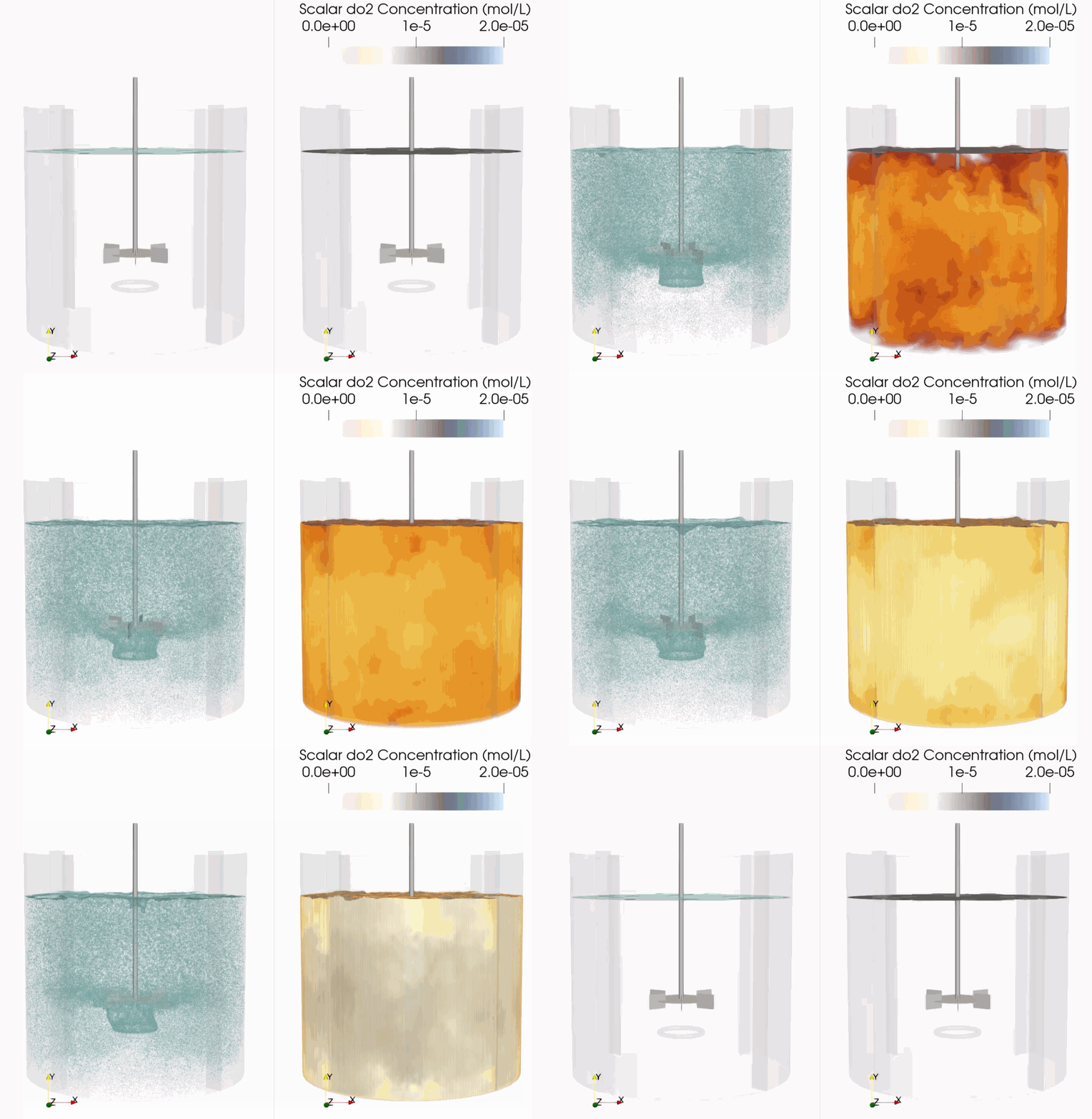
Download Sample File: Scalar Coupling
Mechanically speaking, the convective transfer coefficient describes the rate at which mass is transferred (via convection) through the fluid boundary layer surrounding the particle. This rate is often written in terms of the local fluid energy dissipation rate, fluid viscosity, and fluid diffusion coefficient; although, in many cases a constant transfer coefficient may be suitable.
Theoretically speaking, most convective mass transfer models are developed under the assumption that the fluid immediately surrounding the particle remains fully saturated throughout the transport process. The rate at which mass is transferred into the system is therefore a function of the rate at which the saturated fluid adjacent to the bubble surface can be engulfed into the fluid bulk. These transfer functions can be derived from semi-empirical boundary layer theory.
Conversely, particle dissolution rates are developed under the assumption that the dissolved species concentration is low relative to the solid phase concentration. As such, the transfer rate is often related to the system temperature and the physiochemical properties of the solid rather than to the convective properties of the fluid surrounding the solid. In many cases, the dissolution rate is set to a constant value determined empirically.
- Framework
This parameter determines whether mass transfer is modeled using the convective transfer coefficient or the particle dissolution rate. These values are calculated on a particle-by-particle basis using the local and instantaneous particle and/or fluid properties.
- Convection
This calculates a convective mass transfer coefficient for each particle. Input to this expression includes the local and instantaneous properties of the particle and surrounding fluid.
- kL UDF
m/s | This UDF defines the convective mass transfer coefficient in the fluid surrounding a particle. One output must be defined within the UDF: a floating-point variable named
kl_{Particles}, where {Particles} is the dynamic name of the particle set. This output value is used when predicting convective mass transfer processes, including mass exchange with coupled scalar fields. This is a particle-based local UDF, calculated on a particle-by-particle basis using the local particle/fluid properties.Download Sample File:
kL
- Dissolution
This calculates a dissolution rate for each particle. Possible input to this expression includes the local and instantaneous properties of the particle and surrounding fluid.
- Dissolution Rate UDF
\(\frac{kg}{m^2 \cdot s}\) | This UDF defines the particle dissolution rate, defined here as the rate at which mass is exchanged between the solid phase (particles) and the dissolved phase/solute (coupled scalar field). One output must be defined as within the UDF: a floating point variable named
dr_{Particle Set Name}, where {Particle Set Name} is the dynamic name of the particle set parent.This output value defines the particle-specific dissolution rate. Positive values imply dissolution (mass leaving the particle). Negative values imply precipitation or crystallization. The units on the output variable are kg/m 2 /s. This is a particle-based local UDF, calculated on a particle-by-particle basis using the local particle/fluid properties.
Download Sample File:
Dissolution Rate
- None
No mass transfer coefficient or dissolution rate is calculated.
If Interfacial Mass Transfer is on and a scalar is added, the following section will launch:
Scalar Coupling
- Coupling Method
This option determines if particle-fluid scalar coupling is active in the simulation and whether it is modeled using built-in or user-defined functions. See additional scalar coupling overview.
- Automatic
Predefined convection and/or dissolution models determine scalar transport rate, calculated on a particle-by-particle basis. The units on these properties depend on system setup and must be dimensionally homogeneous. Transport by convection is calculated from the user-specified convective transfer coefficient, the particle surface area, and the differences between the local concentration and the saturation limit. Transport by dissolution is calculated using the dissolution rate and the particle surface area. The same transport model is applied to all species participating in interfacial mass transfer.
- Custom
User-defined transport models determine scalar transport rate, calculated on a particle-by-particle basis. These models could include the user-defined convective transfer coefficient, the user-defined dissolution rate, particle custom variables, or arbitrary functions of the local fluid/properties. A unique transport model can be specified for each species. The user must confirm that the transport parameters are dimensionally homogeneous.
- None
No particle-fluid scalar coupling is considered. Although a convective transfer coefficient or dissolution rate may be defined, no species will be transferred between the particles and fluid.
If a Thermal Field is added, the following section will launch:
Thermal Coupling
The thermal coupling option enables users to model time-dependent particle temperature evolution. Temperature changes may arise from either intra-particle reactions or heat exchange between particles and the surrounding fluid. Intra-particle heat generation or consumption is computed on a particle-by-particle basis, allowing each particle to evolve independently according to its local reaction kinetics.
Heat exchange between a particle and the fluid is likewise evaluated individually for each particle, using the local fluid properties in the surrounding computational voxels. These particle–fluid heat transfer processes are two-way coupled. The heat flux between phases appears as a source or sink term in the fluid energy equation while simultaneously modifying the particle temperature.
- Track Temperature
This option determines if particle temperature is tracked during the simulation. Temperature changes can be caused by endo- or exothermic intra-particle reactions or heat exchange with the surrounding fluid.
- Off
Particle temperature is not tracked during the simulation.
- On
Particle temperature is tracked during the simulation.
- Initial Temperature
K | This parameter defines the initial temperature of the particles in the set.
- Heat Capacity
J/m 3 K | This parameter defines the heat capacity of the particles. The heat capacity informs how changes in the thermal energy affect changes in temperature.
- Fluid Particle Heat Transfer Coupling Method
The coupling method determines if particle-fluid scalar coupling is active in the simulation and whether it is modeled using built-in or user-defined functions.
- None
No particle–fluid heat transfer is considered. The particle temperature changes only due to endothermic or exothermic intra-particle reactions.
- Convection
When using Convection, the species mass transfer rate between a particle and the surrounding fluid is informed by the heat transfer coefficient, the particle surface area, and the local temperature difference between the particle and the fluid,
\[\dot{q}_{T_p} = h_p A_p (T_p - T_f)\]where \(\dot{q}_{T}\) is the heat transfer rate between particle \(p\) and the surrounding fluid, \(h_p\) is the convective transfer coefficient of the fluid surrounding the particle, \(A_p\) is the area of particle, \(T_p\) is the temperature of the particle, and \(T_f\) is the temperature of the fluid surrounding the particle.
Within this framework, the heat transfer coefficient of each particle \(h_p\) is calculated using the model of Deckwer, which combines Higbie’s penetration theory with Kolmogoroff’s theory of isotropic turbulence,
\[h_p = 0.1 C_v (\varepsilon \nu)^{1/4} \left( \frac{\alpha}{\nu} \right)^{1/2}\]where \(C_v\), \(\nu\), and \(\alpha\) are the specific heat (at constant volume), kinematic viscosity, and thermal diffusivity of the fluid.
- UDF
The user defines a custom fluid-particle heat transfer rate.
- Heat Transfer UDF
W | This UDF defines the heat transfer between particles and the surrounding fluid. One output must be defined within the UDF: a floating-point variable named
Qdot. This output variable defines heat flow between the particle and the surrounding fluid. Positive values imply heat transfer into the particle (from the surrounding fluid). Negative values imply heat transfer away from the particle (into the surrounding fluid). The functional form of the heat transfer model is discussed in the particle heat transfer overview. This is a particle-based local UDF, calculated on a particle-by-particle basis using the local particle/fluid properties.
Download Sample File:
Heat Flux
Advanced
- Initial Droplet Diameter Option
By default, the initial droplet diameter is equal to the lattice spacing. Smaller initial droplet diameters can be specified here. This value represents a ceiling on the maximum droplet diameter. Droplets with diameters larger than the lattice spacing are not recommended.
Auto
Custom
- DEM Bounce Method
This options for this method defines how the particles interact with solid bodies. The video below shows the difference between the two options.
- Cell
This is the default option. It is computationally faster than Triangle method. The particles interact with the boundaries of the fluid voxels. Smaller particles, can get caught on the “steps” for coarser resolutions. As the lattice resolution increase, this effect is minimized.
- Triangle
In this option, the particles interact with the triangles made from the tessellation of the static body surface. This is more computationally expensive than the Cell option, but results in a more physically realistic interaction with the static body. The size of the triangles used to represent the surface is set using the edit mesh form. The corresponding mesh can be previewed using the Preview Surface Meshes tool.
- Compute Nearest Neighbor Distribution
Computes the average nearest neighbor separation distance and nearest neighbor separation distance probability distribution function. See additional discussion in Theory: Nearest Neighbor Distribution.
- On
Particle distribution data are computed.
- Off
Particle distribution data are not computed.
- Enable Movement Control
With this option, users can define a UDF that conditionally controls whether particles are moving or fixed. Particle motion can be reactivated as part of the UDF.
- On
Movement control of particles is enabled. Individual particles may become fixed in space per some user-defined condition.
- Movement Control UDF
none | This UDF defines if individual particles move or remain fixed in space. One of two possible boolean outputs can be defined as part of the UDF:
makeFixedandmakeMoving. The values assigned to each value can change over time. If the booleanmakeMovingis set to true, the particle will evolve through space. Only one boolean should be true at each time step. This is a local UDF, calculated on a particle-by-particle basis using the local particle/fluid properties.Download Sample File:
Movement Contol- Off
No controlled movement of particles. Particles always have the ability to move through space.
- Compute Pressure Gradient Force
When this option is active, the pressure gradient force on the particle is calculated. This force acts from regions of higher pressure toward regions of lower pressure, influencing the motion of particles immersed in the fluid.
For a small particle within a fluid, the pressure gradient force can be expressed as:
\[F_p = - V_p \nabla P\]where \(V_p\) is the volume of the particle and \(\nabla P\) is the pressure gradient and the location of the particle.
- Off
Does not compute pressure gradient force.
- On
Computes pressure gradient force.
- Enable Removal UDF
Enable removal user-defined function.
- Removal UDF
no units | This UDF removes particles based on particle properties or local fluid conditions. One output must defined within the UDF: a Boolean variable named
remove. This output value determines if a particle is to be removed from the simulation. If set to true, the particle is removed. This is a local UDF, calculated on a particle-by-particle basis using the local particle/fluid properties.Download Sample File:
Removal
Liquid Droplets Output Data
Particle output data is summarized on the Particle Output Data page. These outputs include individual particle motion and properties, ensemble statistics, spatial fields constructed from the local particle population, as well as particle exit statistics.
Liquid Droplets Toolbar
Context-Specific Toolbar Forms |
Description |
|---|---|
|
The Add Geometry form adds child geometry by importing from external CAD files, extracting from external CAD assemblies, or defining internally using built-in parametric geometry. |
|
The Move form enables three-dimensional rigid body transform of object through free drag or point-to-point snapping. |
|
The Rotate form enables three-dimensional rotation of geometry. |
|
The Scale form enables volumetric scaling of a geometry about a set anchor point. |
|
The Mate form allows surface-to-surface mating and alignment. |
|
The Add Particle Injection adds an injection to a particle parent. |
|
The Add Particle Scalar tool assigns custom properties to individual particles which move with them and can be used to model intraparticle reactions. |
|
The Add Particle Reaction tool applies user-defined kinetics to each particle based on its composition and surrounding fluid properties. |
|
The Add Particle Variable tool defines per-particle quantities via UDFs, accessing particle properties and local fluid conditions. |
|
The Add Fill Point selects which space will initially be 3D-filled with a liquid. |
|
The Diagnostics form reports the position, orientation, and moments of inertia associated with a static body. |
|
The Help command launches the M-Star reference documentation in your web browser. |
 Add Geometry
 Move
Move Rotate
 Scale
Scale Mate
Mate Add Particle Injection
 Add Particle Scalar
 Add Particle Reaction
 Add Particle Variable
 Diagnostics
 Help
HelpSee also Child Geometry Context Specific Toolbar.
For a full description of each selection on the Context-Specific Toolbar, see Toolbar Selections.