Toolbar

The static toolbar is used, among other things, to define the fluid model, add physics to the system, tailor the simulation output, and execute the simulation. The toolbar is located just below the menu and provides shortcuts to menu commands.
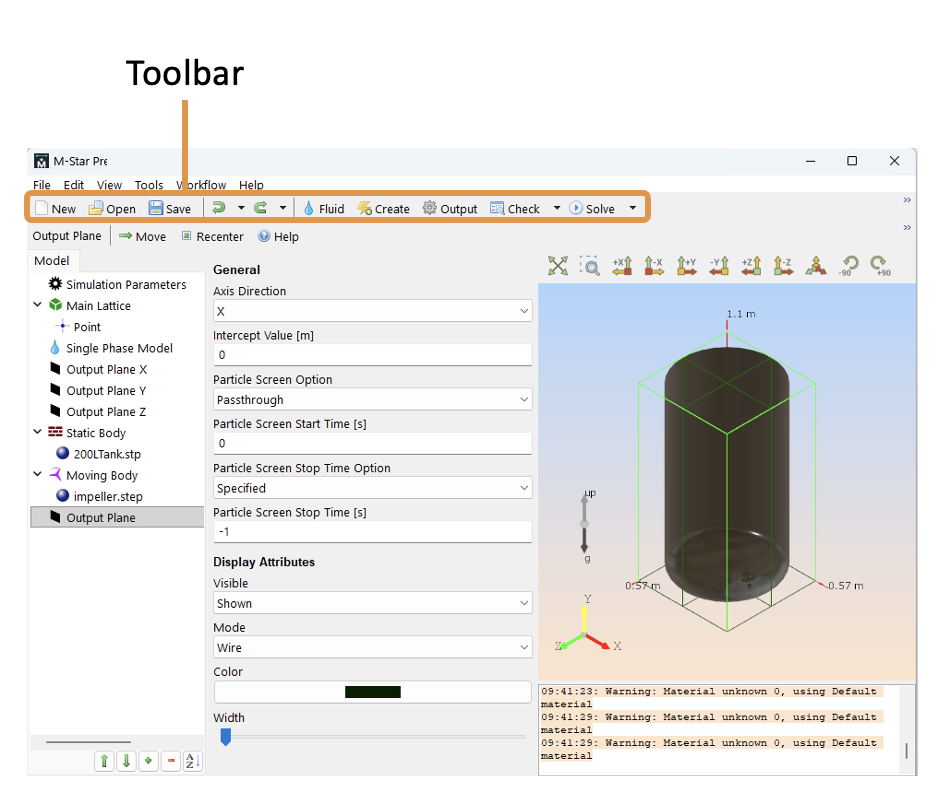
../../_images/toolbar.png

Toolbar Selections

Component

Description

new New

Open new file

open Open

Open a preexisting file

save Save

Save simulation

undo Undo

Undo recent changes to the model

redo Redo

Restore an action that was previously undone

fluid Fluid

Define the types of fluids that will exist in your simulation

create Create

Create the components of your model

  • Fundamentals: Create solid body geometry using built-in parametrics or loading an external CAD

  • Particles: Add Lagrangian point objects such as bubbles or droplets that can assume arbitrary positions in the vessel and participate in reactions

  • Lattice: Add refinement

  • Scalar: Model reactions, thermal fields, and other continuous phase systems

  • Variables: Generate custom values during simulation

  • Runtime: Read and write global variables, apply control logic, and expose reusable functions and tables to UDFs

  • Thermal: Describe the time-evolution of a temperature field across the flow domain

  • Data Sampling: Add additional sampling probes, lines, and planes to your model

  • Data Analysis: Extract deeper insight from simulations

cog Output

Control the types of data output that get printed to disc and the frequency of the data for visualization

  • Statistics: Control text-based simulation data written during a run

  • Planes/Probes: Specify which field quantities are calculated and exported along output planes and surfaces

  • Volume: Specify which field quantities are calculated and exported across the full lattice volume

  • Fluid Interface: Specify which field quantities are calculated and exported along the fluid interface

  • Static Bodies: Control the calculation and export of forces, time-averaged forces, wetted area, and wall-function metrics on static geometry

  • Moving Bodies: Control the export of time-averaged stress and volume fraction data for moving bodies

  • Bubbles/Particles: Control how particle and bubble data are written at both slices and volumes

  • Restart Files: Control the creation of binary checkpoint files used to restart simulations

check Check

Check that your motion types and parameterization are set up properly

  • Check Model: Check for model self-consistency and errors in user-defined functions

  • Preview Lattice: Visualize the lattice that will be created at run time

  • Preview Surface Meshes: Preview the STL mesh that will be generated by the preprocessor for each geometry

  • Preview Motions: Preview the motion of moving objects present in the simulation through 3D space and time

solv Solve

Optimize variables during the solve to automatically create a tailored resolution

  • Run Solver: Find options for exporting data

  • Run Auto-Resolver: Automatically manage resolutions

  • Run Optimizer: Optimize a given quantity by changing an input property

  • Add Parameter Sweep to Solver Queue: Run multiple simulations while varying outputs to study their effects

  • Add to Solver Queue: Build a queue of simulations and run them on GPUs